


How to Choose the Right Size for Loafers?
(The photos in this post are from the official Berwick website)
Welcome to Love Classic Shoes.
We see that most customers visiting Love Classic Shoes stores are first looking for loafers rather than boots or lace-up shoes. Loafers are a model that is consistently loved, especially in the summer and spring. In fact, loafers are shoes that can be worn all year round, except perhaps in winter. Maybe it's because they’re comfortable and don’t have laces. However, for the same reason, it can be challenging to find the right size so that loafers fit well on our feet.
That's why today we'll discuss "what to know before buying" and "how to independently choose the right size" when purchasing loafers.
What to Know Before Buying Loafers
1. Check when your feet swell.
Before buying shoes, it’s important to know when your feet swell. For example, if someone whose feet swell in the evening buys shoes in the morning, trying them on again in the evening might make the well-fitting morning shoes feel tight. Therefore, to choose the size that suits you best, we recommend trying on shoes when your feet are swollen. Not everyone’s feet swell in the evening, so knowing when the swelling occurs can help you buy the right shoes.
2. It is said that no one achieves perfect symmetry when a person is split in half by a vertical line. We are simply not symmetrical.
The shape and size of our feet are no exception. When wearing soft sneakers, the size difference between both feet is almost unnoticeable, but with relatively hard shoes, the difference can be significant. Especially when buying shoes without laces, like loafers, the difference between feet can make it difficult to choose the right size.
In this case, there is no definitive answer, but we usually recommend choosing a larger size for the bigger foot. A size chosen for the smaller foot will cause significant pain for the larger one. On the other hand, if you choose a size that’s slightly loose, there are many ways to compensate for this, so we recommend choosing a size that fits your larger foot, even if it is a bit loose.
3. Sock thickness.
The thickness of your socks is surprisingly important when choosing a size. Thick socks, like sports or wool socks, can make a difference of more than half a size compared to the actual foot size. This is particularly important for shoes like loafers, where the fit changes even with subtle size differences, so when checking your size, remember to wear the socks you usually wear.
4. Differences in the last on which the shoes are made.
Even shoes of the same size from the same manufacturer can vary in size depending on the last on which they were made. The latter refers to the shape of the entire shoe, not its design. Shoes with narrow lasts are tighter on the midfoot than shoes with wide lasts. Therefore, even with shoes of the same brand, we do not recommend blindly sticking to the numerical size designation. The last is indicated in the description of each of our shoes; if in doubt, it's best to call us or send an email (shop@klasycznebuty.pl).
5. Differences depending on the model.
On the other hand, even if the last is the same, the fit can vary depending on the model. The most representative examples are penny loafers and Belgian loafers. For the former, the strap reinforcements on the heel and instep can make them feel initially tighter than the unreinforced Belgian loafers, even if they are made on the same last. Of course, in most cases, choosing the same size would be correct, but it’s good to know that the size can differ due to small details depending on the foot type.
6. Differences depending on the material/leather.
In fact, the material is one of the most significant factors when choosing a size. Even if it's the same model, if you try on suede shoes, you’ll find they’re much more comfortable than leather products. In the case of suede, it is softer than leather, making it stretch well, and the size feels relatively loose. Therefore, when choosing suede loafers, we recommend wearing them slightly tighter than leather ones, and for people with small or narrow feet, we suggest choosing half a size smaller.
Similarly, the choice of size may differ depending on the presence or absence of lining. Products with an unlined structure are relatively soft and loose because the leather is thinner than a general product with attached lining.
How to Check if the Size is Right?
So far, we have looked at things worth knowing in advance when choosing the size of loafers. It looks a bit complicated, but just remember that different factors can affect the size. The most important thing is how you feel when wearing them.
Now let’s look at how to check the most important thing: whether the size is right. If you need to buy shoes online because it’s difficult for you to visit our store (which we regret, as we love customer visits! :)), use the following method to check if the size is right for you.
First, try on the shoes with socks of the thickness you usually wear. Then, when you stand up and take a comfortable stance, check if there is any discomfort in the midfoot or instep. The reason you check your size while standing is that when you stand up, your feet are wider than when sitting. If simply standing is uncomfortable, it means your feet might hurt when you are active, right?
Focus on the point where your little toe touches when wearing the shoe upper. Ideally, the little toe should touch the inner side of the leather as a surface, but you shouldn't feel any sharp pain. Also, if the toes are tightly squeezed and seem to overlap, you could say that the size or last is not well suited to your foot type.
We do not recommend choosing a size that’s too tight from the start in case the leather stretches. This is because the leather may not stretch as easily as expected, and stretching might cause foot pain and shoe deformation. Leather stretches the more tightly you wear it, so if you initially choose a moderately fitting size, you can wear it comfortably and minimize deformation of the shape.
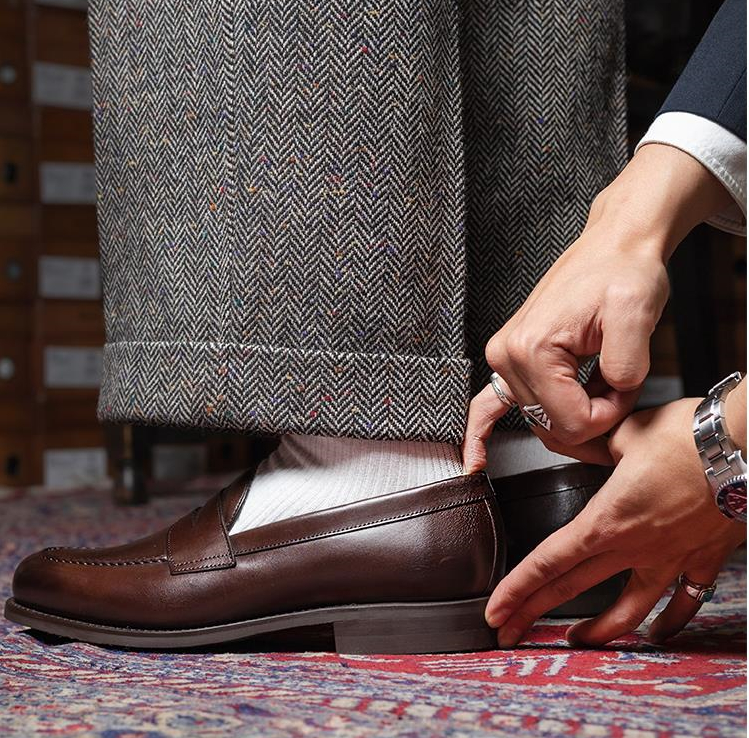
After checking the midfoot and foot size, push your foot as far forward as possible. At this point, as shown in the picture, we recommend a size that has about 5 mm of free space in the heel (half a little finger). This is because when you actually wear shoes and walk, you need a little extra room for your feet to move back and forth in the shoes. If you choose a size that fits tightly to the heel without leaving enough room, there is a high chance that the leather and the foot will constantly rub against each other and cause chafing. With some concern, I notice an “obsession with a flying heel” among some customers. It should initially be loose. In each of my 12 pairs, the heel is loose; despite this, or maybe because of it, I do about 100,000 steps in them per week and feel comfortable.
Berwick
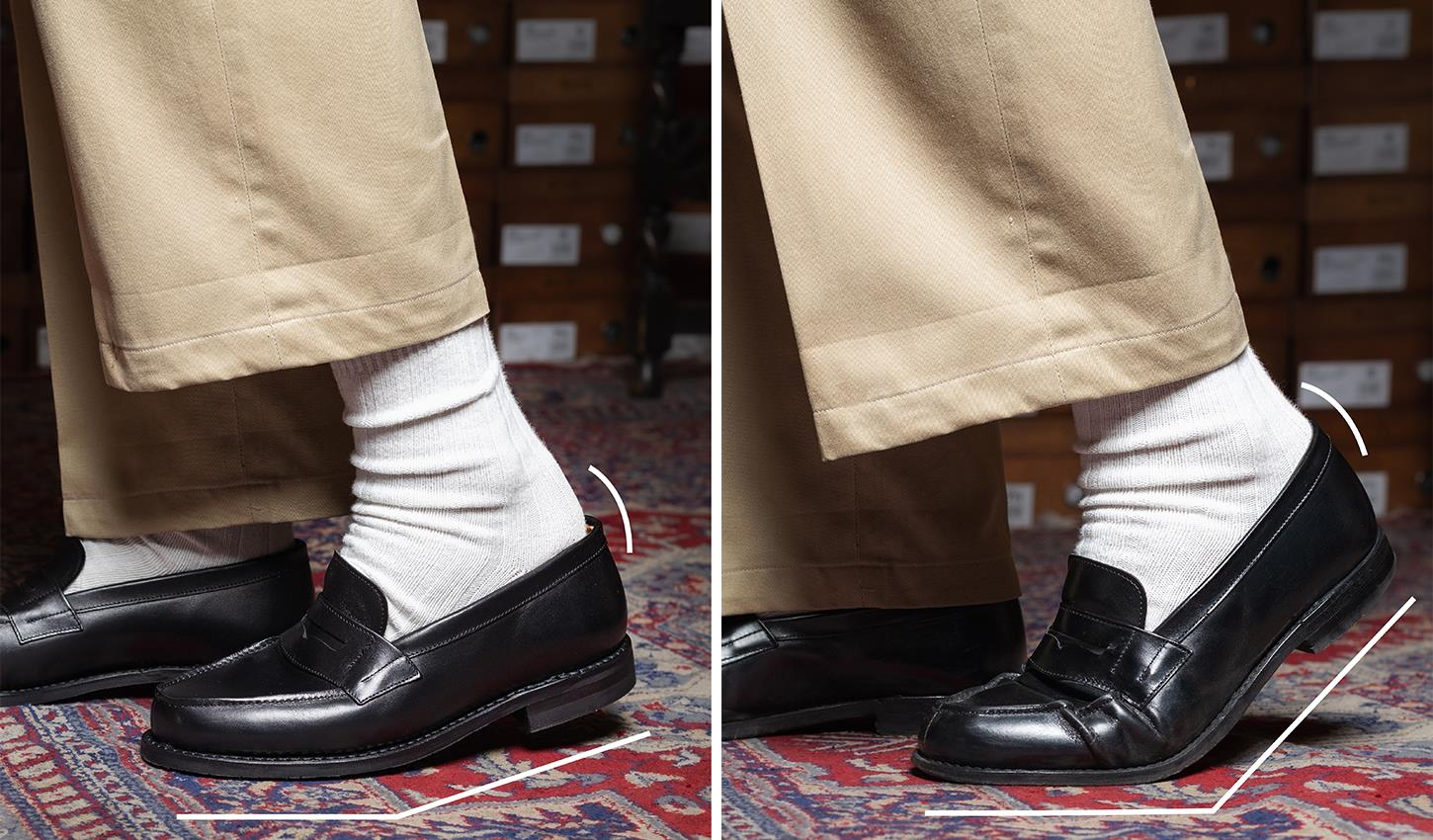
One of the most worrying aspects when buying loafers is “heel slip.” Especially when wearing new products, you may feel the heel lift slightly. If you have the right margin, as explained above, you don't need to worry too much because it’s not too big.
Berwick
The photo above shows the same person wearing a new product and a worn shoe. Despite being the same model and size, you can see that the heel doesn’t slip out of the worn shoes. This is because, when using the shoes, wrinkles form on the back of the foot, and the hard sole gently bends along the wrinkles, gradually improving the slip of the heel. (Due to the structural nature of Goodyear Welt shoes, there are many auxiliary materials inside, so new shoes don’t bend well.) Just give these shoes some time to work and adjust to your feet.
How Can You Help Loafers Fit?
Ideally, you should choose loafers that fit your feet well, but it’s not easy to select shoes that will be 100% satisfactory because each person has a different foot type, and the last maker cannot cover all foot types due to the specificity of ready-made shoes. In such cases, satisfaction can be increased by compensating for the missing part with various “size adjustment methods.” These are shoe insoles and heel pads. Especially when one foot is noticeably smaller, then, according to our recommendations, we fit the shoe to the larger foot and then adjust the size of the other shoe with a heel pad or insole. On the other hand, if one of the shoes is still slightly too narrow, don’t worry either – we can widen it on a shoemaker’s machine – this service is free for our customers.
If you have any doubts, call us at 790507208 or email sklep@klasycznebuty.pl. We will be happy to help you choose the right loafers.
[product id="8005, 8016, 7022, 8018"]